
Mental Note
A Case Study Resolving the aid and flexibility in access to Mental Health Treatments
Where did it start…
Mental health disorders affect a number of people around us each day, yet many go completely unnoticed. These disorders are a battle to be fought daily, and are more common than one might think. Many people seek treatment in mental healthcare discreetly and privately. They are also uniquely affected and influenced by different forms of treatment, yet usually default to classical solutions such as the well known “Talk Therapy” option. There are various treatments made accessible to the public, yet there are a number of individuals that go untreated due to inconvenience at jobs, time, privacy, resources, or stigma. Plus, finding a doctor can take months to arrange an evaluation; and that is even if you had managed to choose one who you are comfortable with, have compatible schedules, and agreeable methods and goals on the first go-around. Many time people interact with a couple different doctors until they find a good match. One of the greatest challenges is finding a treatment provider that have appointments aligning with work, family, and other daily routines that are difficult to reroute on a regular basis. This challenge is faced by many and can be an added stress just to fit in what should be a stress relieving activity, into your daily routine.
For some, myself included, have found it difficult to maintain “normal” appointment bookings while trying to balance daily activities, even something as simple as fitting the appointment into your work day. In one light, you want to connect with a doctor as soon as possible to begin treatment, but the doctors that are first available after daytime hours are usually booked first because the non-work conflicting appointments are usually booked up first. The next step was find an available doctor who you are compatible with in goals, and personality. Putting the obvious complications like health insurance aside, apart from having like schedules, do the two of you have similar understanding and agreements on the goals of your appointments? Are you both looking to treat and focus on the same topics? And does the care provider that you are paired up with specialize and have any trained skills that might aid in your treatment process? Lastly, when you are finally paired with a care provider that meets your needs, it’s time to begin attending appointments, but that means interrupting your work day or daily obligations. With the midst of the pandemic, most doctor and care providing appointments have been shifted to digital and remote attendance. (Based on interviews, users had mixed feelings on this factor.) This factor takes finding a private location for your appointments as a new element to add to your process, and especially in the middle of a work day, this can pose some additional challenges. In most jobs, the flow of your work day can have unpredictable bouts of excitement and busyness. Having to obligatorily step away in the middle of a meeting, project or work flow for the appointments can be stressful and inconvenient. You may find yourself asking to reschedule the appointment, rushing through the process, or even having to cancel to meet the needs of the other factors in your life. The example is just my experience on a personal level and doesn’t even include those that are in more high pressure job positions, leadership roles, and even family life of juggling the responsibilities or multiple schedules.
Understanding the problem and the need…
Originally the focus of this journey was to create a time friendly application that allowed the patient to interact with his/her doctor at their own ease and inconvenience, be it timing, location or date. Research and user interviews, however, revealed that patients not only faced a struggle in timing and frequency, but also available forms of treatment, and accountability in the supplementary tasks such as journaling or exercise. The problem had then shifted from how can we create a solution that met needs of patients in terms of access to appointments, but now to include an all encompassing access to multiple forms of treatment and timing. The problem at hand was How might we create an all access form of communication between the patient and care provider that met the needs of timing, privacy, variety, and multi-treatment access?
The questions to solve at this point were:
What if there was a means for the patient to have the ability to record his or her own thoughts, feelings, expressions, and emotions at a time that was uniquely convenient time?
What if there was a resource that aided flexibility in the treatment styles and schedules between doctors and patients?
What if patients had access to various forms of treatment under one roof?
With these questions to answer, comes assumptions that we are making about our users.
How technically inept are the users?
Do they have access to technology to attend the appointment and interact with a session?
Are they covered by medical insurance to access treatment from a doctor and care provider?
How effective are the forms the treatment that are being offered, and do they want added treatment methods to their talk therapy sessions?
What would house all these files and content in a safe and confidential place?
Do the users want the write responses to everything that they do in the application or will the writing feel like a chore?
Are users interested in remote appointment when the pandemic is over?
Do users want virtual interactions instead of live talk sessions with immediate responses?

After interviewing prospective users, there were some common grounds that were discovered the desire and curiosity to experiment with alternative forms of treatment. One user even said that if they had the access to opportunities like Art Therapy or Music Therapy they would give it a try. Another also said that while they found journaling and exercise to be helpful, it was hard for them to stay regularly committed without being held accountable to undergoing these forms of stress relief. Lastly, users discussed how they had songs/music and visual aid that helped them better interrupt how they were feeling and found it difficult to share these resources with the doctor remotely. In person they felt like they had access to sharing music or art via their cell phone, but with the remote shift it was difficult to share resources. Some commonalities that were gathered through the interviews were placed in an Affinity Map to better dissect the details of the interviews.
Each question asked in the interview and screening process was recorded and surround by the responses that were gathered. The user thoughts were then broken down into individual concepts in the lighter hued notes, and the white notes were added to present questions and observations that were made based on the responses. It was very interesting to see how much of an interest other had in self care, such as journaling and exercise, and to see a growing curiosity in other forms of treatment.

Understanding the users…
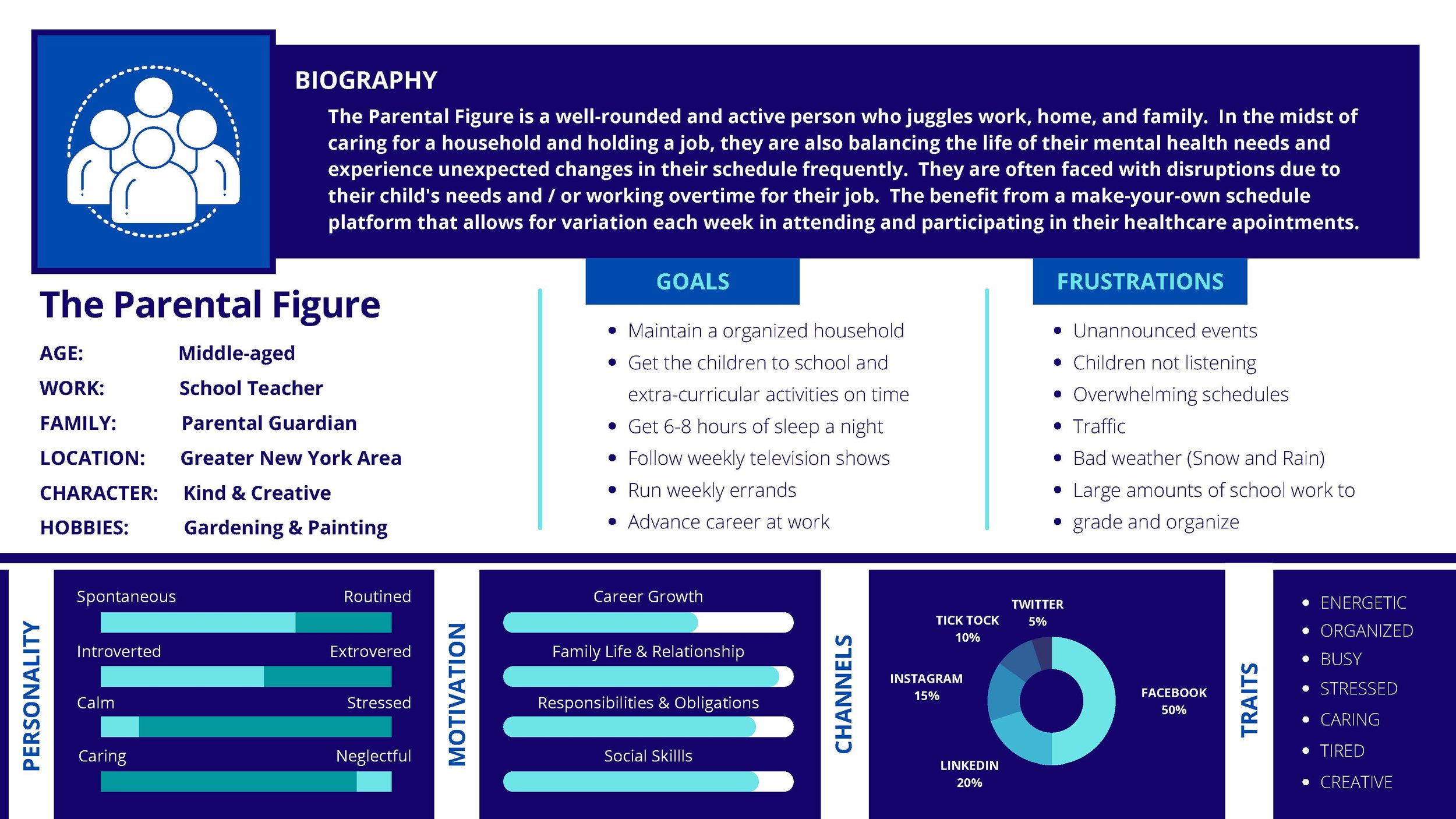
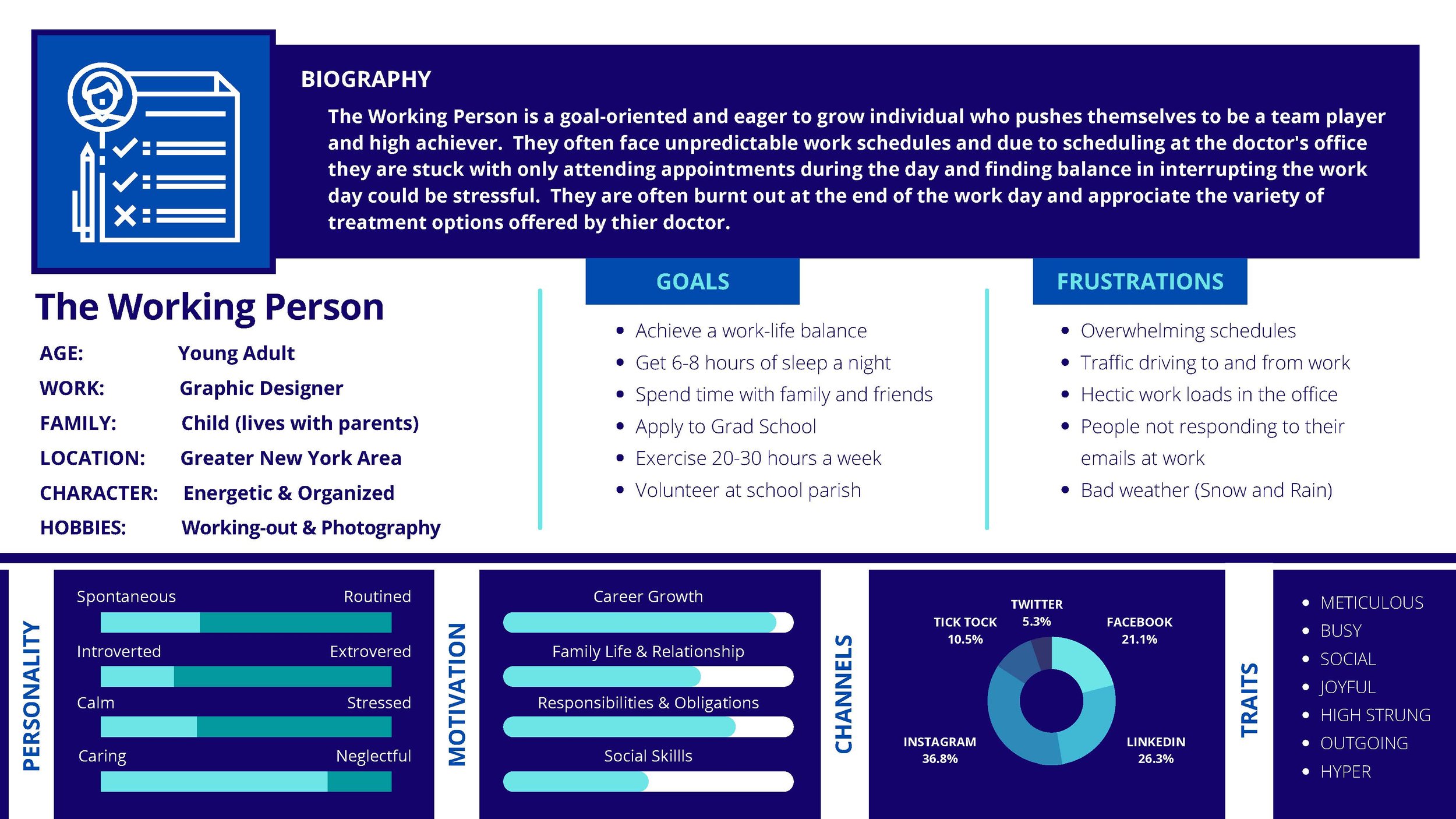
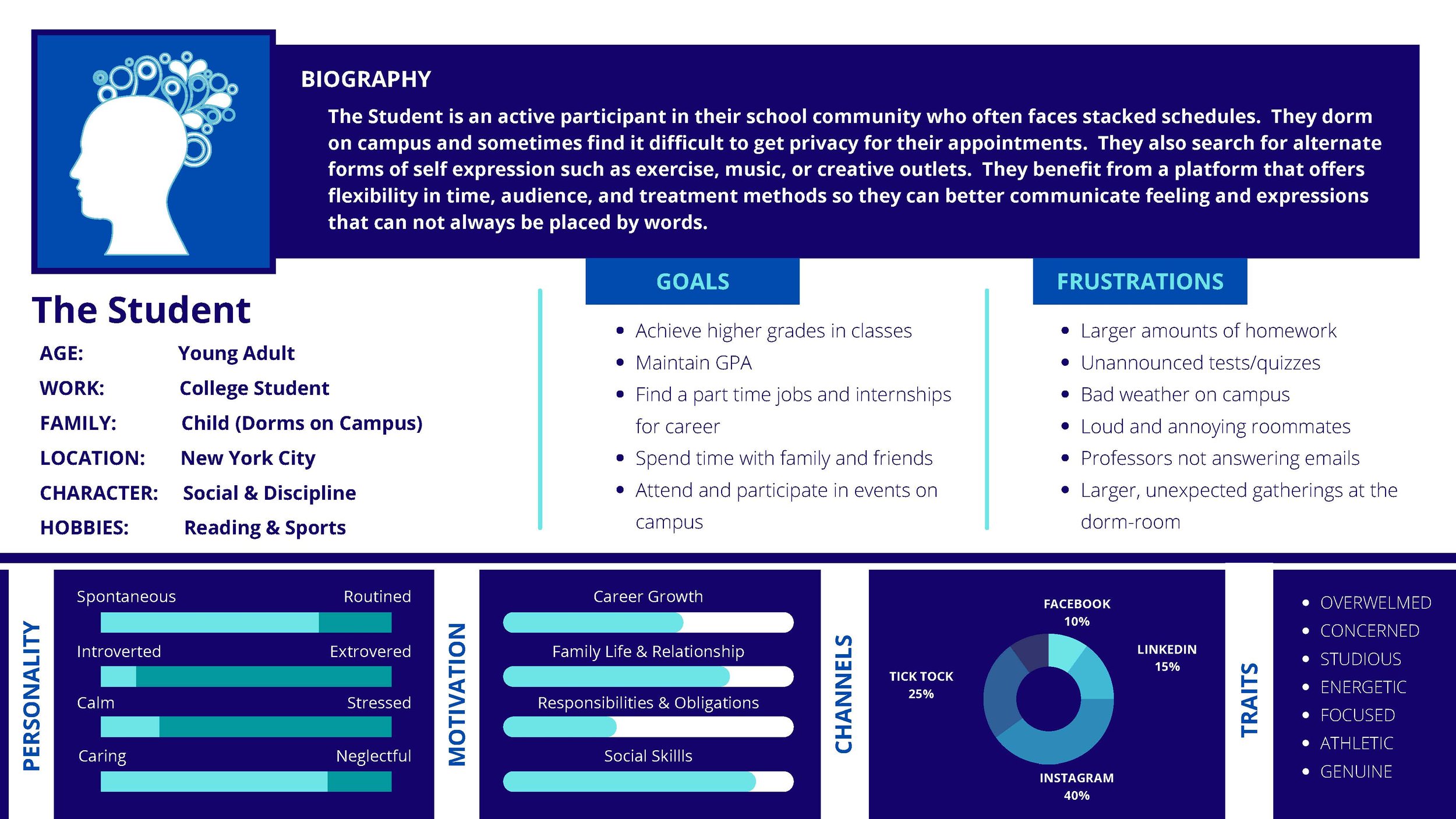
After speaking with approximately a dozen users, different personas started to become form. While each had different characteristics, such as treatment goals, frequency, and responsibilities, there were some traits that were similar like the dedication to their treatment process and mental health care plan, unpredictable schedules, and privacy. “The Working Person” is a young and eager, goal oriented person who has their time competing with work, school and daily life obligations. They feel stressed stepping away from work with the fear of being ill-percieved by walking away in the middle of the work day due to obligations. “The Parental Figure” struggles with similar life structure, but instead battles with competing schedules between their own personal routine and obligations and including the schedules of everyone in their family. Like “The Working Person” they have difficulty obtaining privacy for their appointments, even though in their case the appointments don’t conflict with work. At this time they battle watching/helping the kids, juggling after school activities and house-hold obligations. Lastly you have the student, a social person whose schedule differs much more than the other two personas. They deal with a different life dynamic and structure, yet also face a struggle to find balance and privacy.
Developing the Structure…
With one of the goals in the app to create a adaptable and multi-point source of treatment access, users where surveyed to find what forms of treatment they used to treat mental health complications. The most common responses other than Talk Therapy were Journaling, Art and Coloring, Listening to Music., Exercising, and Meditation. This influenced the development of 5 major sections: Journaling, Art Therapy, Music Therapy, Exercise, and Meditation. A sixth section was also added to the structure later called Health Records, after users during testing expressed an interest in knowing their medication details and status, as well as sharing the information with their other doctors. With this section, the goal was to monitor medication status, especially with/for patients that frequently switched doctors or care providers, or were in the midst of trying out a number of different medications to find what most like to call “the right cocktail”. Each of the 5 treatment sections are similar in structure and in ability to can write a response relating or reflecting on the corresponding element (piece of art, recording, song, or topic) in that section. It was also created to build a profile of important details, resources, and aids that the patient would like to share with the care provider, something that would be difficult to do as a remote patient.
-
Pre determined Journal Topics, supplied by your care provider that are relevant to the topic discussed in your treatment plan. Additionally there is a write your own section of the provided topics allowing you to write and log any information that my be on your mind that is not covered in the supplied entries and topics.
-
Offers two key opportunities: To virtually share content that you created with your care provider and to spend time creating and reflecting as a form of treatment. There is a view previous entries section that allows you to go back and read/view prior responses on work that you have uploaded or created. There is also a create your projects tab which give the opportunity to either upload a picture of external work that you have created, or to use an application such as Mandala Coloring, Drawing, or Fluid Stimulation, as well as other applications that can be added to your project library. Throughout the course of work and/or uploading content, your are at any time, made accessible to the journalling tab at the bottom of the screen which allows you to write thoughts or responses as your work, right within the application
-
The Music Therapy option offers a similar structure to that pf the Art Therapy section. Your are given two options: View Previous Entries, and Listen to Music. When you are viewing previous entries you have the ability to re-listen to the song that your wrote your entry with, as well as re-read or edit your entry. In the listening to music tab, you are supplied with three options. There is a listen to saved music tab, where you can access music that you have already saved to your portal, you can upload music from google, and lastly, you can listen to external stations like Spotify or Pandora. Each of these three options have open access to being about to swipe up and add your thought and opinions to a journal entry (which would later be saved to the “Previous Entry” tab at the start of this section.
-
The Exercise section was aimed to create a log, focusing on accountability to a supplementary source of treatment to your treatment plan. Like the previous sections, you can view earlier entries and edit accordingly. In the “Add a New Activity”section you are provided a very brief source of recording your workout details. The goal of this page is not to supply or complete with that of a fitness tracker. It is to create a brief log of exercise on dates, and provide that opportunity to record your thoughts and details during the workout. There are three main components to filling out the information for the data entry: Date, Activity, and Duration. The activity section as a search bar where you can enter activities and then mark them as favorites to enter in future entries. Additionally, you have access to a response section where you can record an entry displaying your thoughts during your workout session.
-
The Meditation Section has a similar suite to that of the Music Therapy Section. There is access to previous entries for viewing and editing, but the primary goal of this section is store meditation recordings that are recording during your sessions or supplied by your care provider. This servers as a safe and confidential access point to revisit and discuss meditation recordings. Like the previous sections you are also given the option to swipe up to write and record a written response to the track that your are listening to during your reflection.
-
The Health Records tabs was added as a solution to some requests during user testing. Users were interested in having a record to previous medications and medication detail. Here is you can view the brand/generic name of your prescription, amount of refills available, date that it was prescribed, and any notes that the doctor may have about reactions or effectiveness of the medication
Aside from the six main treatment sections that are made available to the patient, there are also some basic options made available to access. In the menu bar at the bottom of the screen there is a notifications tabs that lets you know when your care provider has responded or viewed one of your entries in a section. There is a messages section that serves as a live chat for your to communicate with either of your doctors in real time, just as you would in a text message, except this lives in a confidential space. There is a settings and configurations tab, allowing you to change your alerts at any time. Lastly there is a call tab, this section gives you access to the doctor(s) contact information (Phone Call, Direct Message, or Email) where you can reach them directly. Your can also view a brief biography of your doctor, such as their mission, specialities, and background.
A series of task and user flows were developed to build out a skeletal structure as to how the application’s process and functional assets would be displayed. There was also a series of user journeys that provided insights through the eyes of the user/personas as they accessed and navigated their way though the application. The demonstrate simple tasks that would be conducted such as utilizing basic features of the application.
The Design Process…
The initial direction of this application was very different from the outcome. At the start of the research process, there was an idea that an application would be created centered around the idea of writing on a tablet, and that the act of write could be viewed as a therapeutic process. After developing the user interviews and hearing that others were interested in the idea of other forms or treatment, or that they were independently taking part in similar treatments the concept had shifted to the basis of working on an all access point that made a one stop shop for multiple forms of treatment. The idea that of sharing a mutual ground between the patient and the doctor had become the focus of the application.
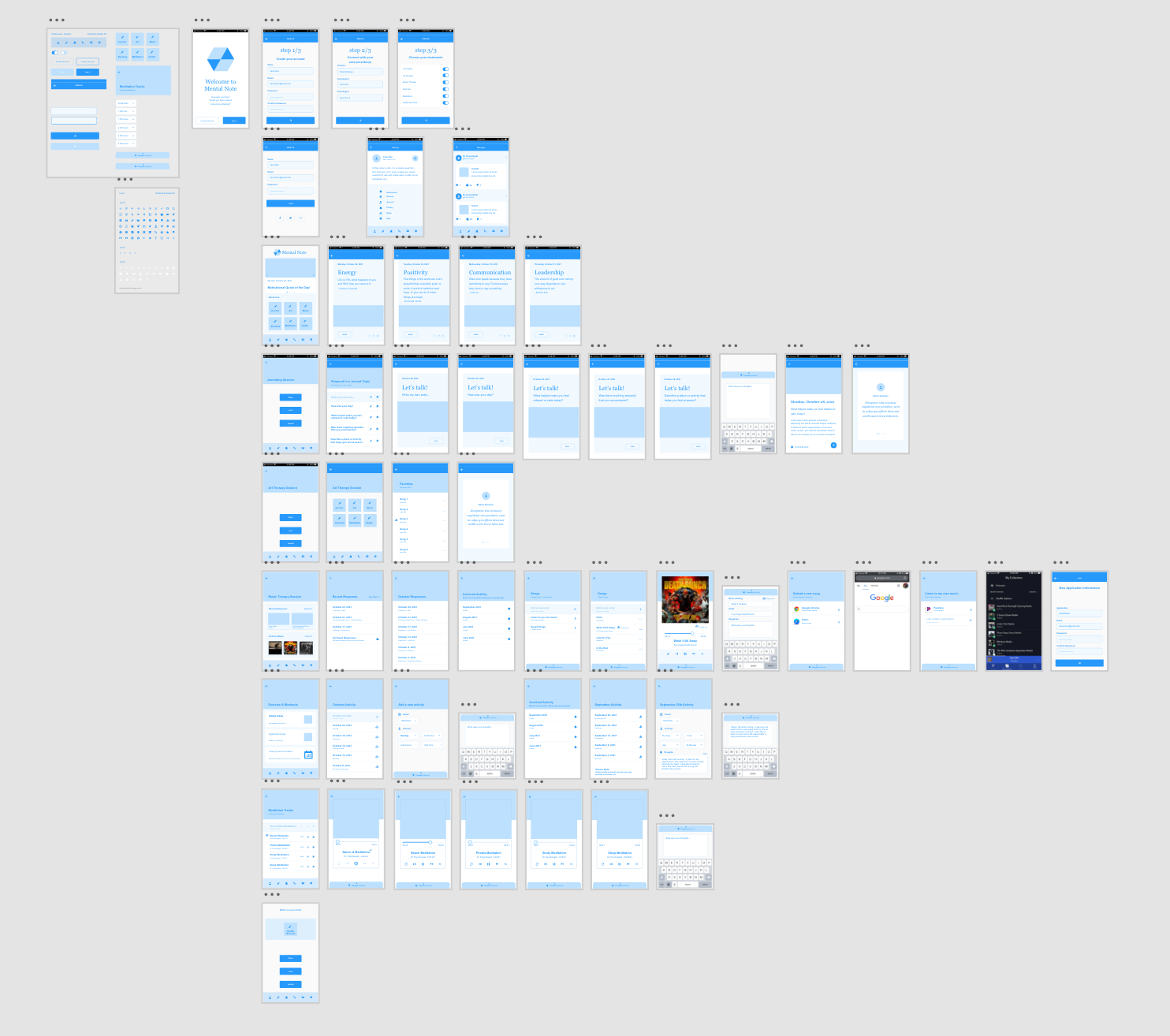
Below is a preliminary layout of the application in its basic structure, followed by the final layout of the screens in the application. After user testing and furthering the design the application’s structure more screens were added and the details began to be flushed out. There were user testing conducted periodically throughout the design process that helped shape and fine tune the details and elements in the application.

Reflection and Next Steps…
The over view of the application by users was that there was a very direct and straight forward navigation process of the application. There was question of how much patience the user would have in being willing to type journal/diary entries on a regular basis. The hope in solving and easing the worry of this factor was that the application and keyboard could transpose audio recordings / voice commands in the way that Siri can translate voice commands. In the long run, there is the consideration that the application would have an artificial intelligence that learns about the user based on their profile. It would be able to recommend/suggest prompts that the patient could answer based on the entries that they have been recording. I could also suggest alternate forms of treatment that the patient my have not initially selected during the on-boarding process. For example maybe the application has learned that the user listens to a lot of music in effort to relax. The application may suggest that the user try meditation as an alternate form of treatment. Another factor that I would like to advance the application to would be to bring it to other devices like an I-pad. With the compatibility of an I-pad configuration, the user could have the opportunity to physically write with a stylus (just as ideated in the initial development process). The physical act of writing has studies that show that it could have therapeutic effects. Currently the way to achieve this effect is the user writing on a sheet of paper and uploading a picture of the entry with their phone.